
Run your tongue over your back teeth and you will feel the problem: the chewing surfaces of molars are a landscape of pits and grooves. Those grooves grip food, which is useful for chewing, and they also grip food debris and plaque, which is exactly how childhood cavities get started.
A dental sealant is a thin protective coating painted onto the chewing surfaces of the back teeth, where it flows into those grooves and hardens into a smooth shield. The application takes a few minutes per tooth, involves no drilling and no numbing, and it dramatically reduces the risk of cavities in the very spots where children get most of them.
If you have a child in the age range where adult molars are arriving, sealants are one of the highest-value, lowest-drama things you can do for their teeth. Here is how they work, when the timing matters, and the honest limits of what they can do.
Why Back Teeth Are Where Childhood Cavities Happen
The grooves on molar chewing surfaces are often narrower than a single toothbrush bristle. A child can brush diligently, twice a day, with good technique, and still leave the bottom of those fissures untouched, because the bristles physically cannot reach in. Plaque that settles there sits undisturbed, acids build after every snack, and decay begins in enamel that is still young and comparatively soft.
That is why the chewing surfaces of the first and second permanent molars account for such a large share of childhood cavities. Fluoride, from toothpaste and from treatments at cleanings, does great work protecting the smooth surfaces of teeth, but it is least able to help deep in the grooves. Sealants exist to cover precisely that gap.
What A Sealant Is, And What Getting One Looks Like
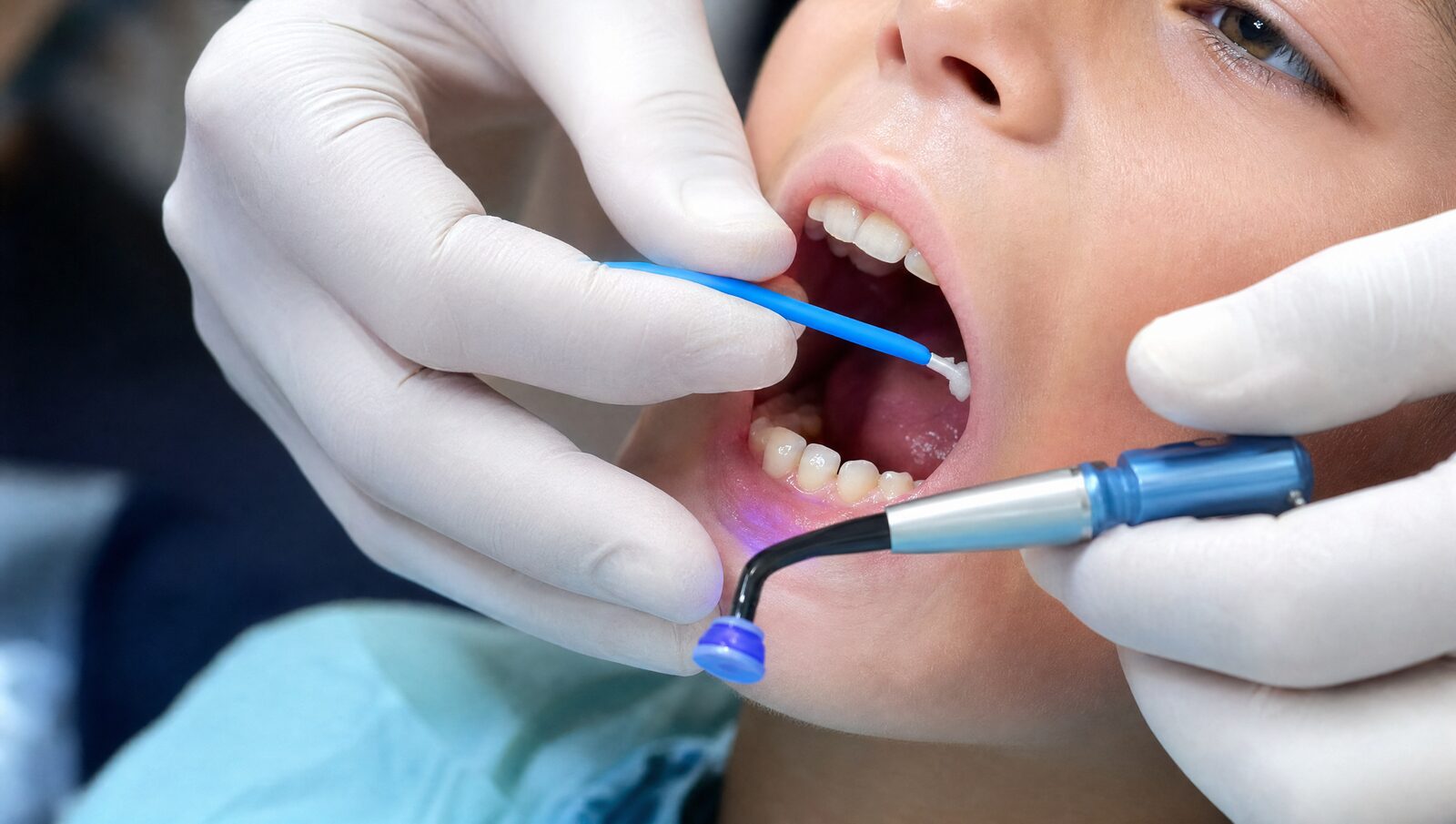
A sealant is a liquid resin, usually white or clear, that bonds to the enamel of the chewing surface. Once hardened, it turns the pitted landscape into a smooth, easily cleaned surface and physically blocks food and plaque from reaching the depths of the grooves.
The visit itself is genuinely easy, which matters when the patient is seven years old:
- The tooth is cleaned and dried. Any plaque in the grooves comes out first, often as part of a regular cleaning appointment.
- A conditioning gel goes on for a few seconds. It microscopically roughens the enamel so the sealant can grip. It is rinsed away and the tooth is dried again.
- The sealant is painted on. The liquid flows into the pits and fissures.
- A curing light hardens it. A few seconds of blue light and the coating is set. The tooth can be used for lunch the same day.
No drilling, no shots, no removal of tooth structure. For most kids the strangest part is the small blue light. It is about as close to a free win as dentistry offers, and it is a natural add-on to a routine checkup visit rather than a separate trip. For a wiggly six year old, that ease matters twice over: the visit stays short, and the child walks out with a good memory of the dental chair instead of a hard one, which pays dividends for every appointment that follows.
The Timing: Two Windows That Matter
Sealants protect best when they go on soon after a tooth erupts, before decay has a chance to start in the fresh grooves. For most children that creates two key windows:
- Around age 6. The first permanent molars arrive at the back of the mouth, behind the baby teeth. Parents often miss them entirely because no baby tooth falls out to announce them.
- Around age 12. The second permanent molars erupt behind the first set, opening a second round of vulnerable grooves.
Premolars with deep grooves can be sealed too, and in some cases baby molars are worth sealing, particularly for a child who has already had cavities. Timing is checked tooth by tooth at regular exams, which is one more reason the every-six-months rhythm of family dentistry earns its keep: the right moment to seal each molar is easy to catch when someone is watching for it.
And sealants are not only for children. An adult with deep, cavity-prone grooves and no existing fillings in those teeth can benefit from the same protection. It is simply most valuable in the years right after eruption, when enamel is newest and brushing habits are still a work in progress.
How Long Sealants Last, And What They Cannot Do
Sealants hold up to years of chewing. They gradually wear, and a sealant can chip, so we check them at every exam and touch up or reapply where needed. Reapplication is the same quick painting process as the original.
Honesty requires the limits too:
- Sealants protect chewing surfaces, not the whole tooth. Cavities between teeth are stopped by flossing, not sealants. Brushing and fluoride still do the heavy lifting everywhere else.
- They are prevention, not treatment. A tooth with an established cavity needs a filling; a sealant cannot be painted over active decay and left alone.
- They are not a license to skip checkups. Sealed teeth still get examined, because the seal has to stay intact to keep working.
Framed correctly, sealants are one layer in a simple defensive system: brushing with fluoride toothpaste, flossing, sensible snacking, regular cleanings, and a physical barrier on the surfaces brushing cannot reach.
Sealants And The Rest Of The Prevention Toolkit
Parents sometimes ask whether sealants replace fluoride, or whether fluoride makes sealants unnecessary. The honest answer is that they are teammates covering different territory. Fluoride strengthens enamel everywhere and is most protective on the smooth faces of teeth and along the gum line. Sealants protect the one terrain fluoride reaches least, the deep chewing grooves. A child benefits most with both in play, plus the unglamorous fundamentals.
Those fundamentals deserve one paragraph of their own, because they multiply everything else. Brushing twice a day with a fluoride toothpaste, flossing once teeth touch each other, and keeping sugary drinks and grazing-style snacking in check do more for a child’s cavity count than any single procedure. Frequency matters more than quantity with sugar: enamel gets attacked by acid after every exposure, so sipping juice across an afternoon is harder on teeth than finishing it with lunch. Add checkups every six months so small problems are caught while they are still small and cheap, and sealants become the finishing layer on a system that already works.
Are Sealants Safe?
Yes. Sealants have been placed on children’s teeth for decades and are recommended by the American Dental Association and the American Academy of Pediatric Dentistry. Questions occasionally come up about trace BPA exposure from dental resins; the amounts involved are tiny, exposure is brief, and the pediatric and dental communities’ position is that the proven cavity prevention far outweighs it. We are always glad to talk through the materials we use; bring every question you have to the visit.
Frequently Asked Questions
Does getting sealants hurt?
No. There is no drilling and no needle. The tooth is cleaned, conditioned, painted, and light-cured. Most children describe the conditioning gel as tasting sour and that is the extent of the discomfort.
Can my child eat right away?
Yes. The sealant is fully hardened by the curing light before your child leaves the chair. Very sticky and very hard candies are worth moderating in general, both for the sealants and for the teeth themselves.
Will anyone be able to see them?
Sealants are clear or tooth-colored and sit on the chewing surfaces of back teeth, so they are essentially invisible in normal life. They do not change how teeth look when your child smiles.
My child already brushes well. Are sealants still worth it?
Good brushing is essential and still cannot reach the bottom of molar fissures, because the grooves are narrower than the bristles. Sealants protect the one area where even perfect technique falls short.
Are sealants covered by insurance?
Many dental plans cover sealants for children on permanent molars, often up to a specific age. Our front office checks your plan’s specifics and reviews insurance and financing details with you before the visit, so there are no surprises.
A Few Painless Minutes Now, Years Of Protection After
The molars that erupt around ages six and twelve have to last a lifetime, and the first few years after they arrive are when their grooves are most vulnerable. Sealing them is quick, painless, and quietly one of the most effective preventive tools in dentistry.
If your child is due for a visit, our $75 New Patient Special covers a comprehensive exam and full digital X-rays, and it is the natural moment to check whether new molars are ready to seal. Riverside Dental treats families across Sherman Oaks, Studio City, Encino, Valley Village, and Van Nuys from our office at 12926 Riverside Dr, Suite D, Sherman Oaks, CA 91423. Call (818) 784-5889 or book through our contact page, and we will make the visit an easy one for your child.